Wednesday, January 05, 2011

St Remy de Provence and the Ancient Town of Glanum

Staying in St Remy was a luxury - it was relaxing and gave us a chance to feel part of the village.
The café near the square would become our local resting spot at the end of each day. As mentioned previously, St Remy had a population of around 11,000 and was the perfect sized village in our opinion. It suited the style of holiday village that we like. People are friendly to you as you become more a part of their day, especially when every morning you wander up to buy your baguette and croissants for breakfast. We had a Boulanger across the road from our villa.
St Remy also had some good local historical sights and close to many in the outlining areas. A week gave us the opportunity to travel each day sightseeing but the two most interesting places were at our doorstep.
GLANUM
It was my morning ride that I passed these two amazing structures to the right of me. I had to stop to take a photo and as I read the description I discovered that to the other side of the road was the ancient town of Glanum. Only two kilometres out of St Remy and set in a small valley, the town was only discovered in the 1920s. I raced home for breakfast and to tell Sue of “my” discovery. There would be more of these discoveries on my morning rides that I would share with Sue later.

Glanum was situated at the opening of a small gorge with a spring feeding water through the town. The spring served many purposes for the inhabitants. It gave life to the town and it was dedicated to the god “Glan”.


The ancient Gallo-Roman town of Glanum with the Alpilles range on the horizon.


Looking down the valley from where the spring brought life to Glanum.

This map give a similar view from the picture above.

From Wikipedia - (It describes Glanum much better than I can)The city, founded by Celto-Ligurians and subsequently Hellenised as Glanon, was already old when it became a Romanised settlement in the first century BC; a shrine to the Celtic god Glanis (glann, "shining"), who was associated with a local healing spring, had been erected on the site in the fourth century BC. The Romans adopted the shrine and the divinity, naming the town after Glanis, and also adopted a triad of local mother-gods, similar to the Matres, whom they termed the Glanicae. The gods Epona, Mercury and Rosmerta were also represented there. The Augustan age saw the city elevated to the status of colonia, and many monumental buildings were erected, including an enlarged forum, baths, a triumphal arch, and various temples (some of which were erected by Augustus' general and son-in-law Agrippa).


Glanum was destroyed by the Alamanni in 260 and was subsequently abandoned, its inhabitants moving a few miles north into the plain to found a city that later was named Saint-Rémy-de-Provence. Glanum was not excavated until 1921, but has since become one of the most important Roman excavations in France.

Up until 1921, the town had been covered by silt and was actually covered by an olive grove. During Van Gogh’s time in St Remy (another story for later) he painted many olive trees and olive groves. One may have been on the very site of Glanum.

One in particular shows the outline of the Alpilles mountain range with a distinguishing feature that can be seen today as you stand where Vincent painted the scene.

Olive Grove painted by Van Gogh - I stood at this very spot and could see the same scene or the Alpilles range on the horizon.
I wondered if this was the spot where some of Glanum was lying below the Olive Grove.

Glanum will always be a highlight of our stay in St Remy.

Footnote - Unfortunately, I've lost several of our photos of our time in St Remy and have used ones on the web to illustrate our time there.

Sunday, January 02, 2011

BACK to BEECHWORTH

Grab a cuppa - this is a big one...
It was 30 years ago (sounds like Sgt Peppers, doesn't it!!!) that we spent some time in Beechworth - an old gold mining town of the early 1880s. We went on a wine discovery trip there in the early 80s.
Today it preserves its rich heritage and is full of businesses trying to make a living from tourism.
Gold discovery brought with it prosperity. The town grew from a tent city to the central hub of the northern hill country of Victoria sitting at the base of the Victorian Alps. Radiating from Beechworth are many other townships worth visiting, Bright, Yackandandah, Milawa and gateway to the Alps.


Beechworth - a great base to visit the surounding areas of wine, food and the Alps.
 Gold was discovered in February 1852 after which 8000 miners flooded the area of “Mayday Hills” before it was named Beechworth. In less than 2 years, 100,000 ounces of the precious metal had been mined in the district. Miner’s shafts still litter the area and tourists are warned of the dangers that can be encountered if not careful.

Beechworth's Post Office

Bank of Victoria, now a museum, cafe and gift shop.

Australia's coat of arms - Kanga and Emu above another old bank, now an antique shop and B&B.

By 1853, the Government laid out the street plans and a town was born. In one more year the population grew to 30,000, public buildings were erected and Beechworth became the centre of the Indigo Shire.

It is in the Beechworth Courthouse that sentence was handed down to infamous bush ranger, Ned Kelly before being sent to Melbourne to be hanged.
The afternoon of our arrival in Beechworth, Sue unfortunately wasn’t well - food poisoning. It happened to me earlier this year when we visited friends in the Loire in France. I still have to continually apologise to Carole and Mikee, our hosts (Hope you’re reading this. Sorry again).

So I decided to take a lone walk with my camera while Sue slept.


Beechworth Goal.


The entrance to one of the towers.


The Shire Hall is now the information centre for tourists.

The historical centre of Beechworth has been preserved and contains the admistration buildings from the 1850s including the Warden's office, Courthouse where infamouse bushranger Ned Kelly was tried and convicted, and the telegraph station among othe administration buildings of the time.


The only part of the Beechworth Hospital remaining is the Facade shown here.


Beechworth is full of magical buildings, small cafes and even a boutique brewery, not to mention the opportunity to purchase the many fine wines from the local district. A real gourmet and craft trail has emerged from the district. The town has basically two main commercial streets that criss-cross each other. The traditional verandas remain and the signage of the shops and businesses take on a theme of the earlier era of the 1880s. Banks were big in that time and so were hotels, of which many remain. The banks are no longer handling money in the sense of savings but still do now in tourism dollars. They have become antique shops, restaurants or museums.

Some of the hotels and I counted maybe five within the two streets, have become a little more upmarket since their 1880s days.

Tanswell's Hotel is one of the earl hotels still remaining from the 1880s. We stayed here in the early 1980s and asked for  a bottle of wine to take back to the room. The owner took us deep down into the cellar to extract a bottle of vintage red at some extraordinarily CHEAP price. Betcha that don't happen these days.
 As I wandered up Camp Street, I found the local boutique brewery and thought it was a good time for a cool beer - a Beechworth Porter, a dark ale, but not quite a stout.

A morning walk the following day took me to a little café with very much a French influence (the owners travel to France regularly) and I enjoyed a coffee with scones, raspberry jam and cream while I read my book in the filtered morning sunshine in their garden. Life is good.

The book I'm reading is a biography of Paul Kelly, an Australian singer songwriter. He's a very interesting fellow with a social conscious.
Check out this youtube of him. He sings of Aboriginal land rights.


A really nice place to relax and read a book over a cup of coffee.

On leaving a had a French thing happen and the bill said Merci.
 After leaving Bouchon Cafe, I wanted to search out the Beechworth cemetary - it has some of its pioneers buried there and a section for the Chinese that inhabited Beechworth during the gold rush days.
I found the cemetary but discovered that I was all alone, not a soul was seen on my walk amongst the graves. Of note was the grave site of James Ingram, Beechworth's Grand Old Man. He arrived in Beechworth in 1855 three years after the gold discovery at the age of 27 after setting foot in Melbourne from Scotland in 1852. He died six weeks before his 100th birthday after achieving much for his adopted local community of Beechworth and Victoria.
As I walked the grave sites, I discovered many that had arrived from other countries to make this area what it is today. Pioneers from the UK, Canada, United States, Germany and of course the Chinese who set up market gardens and laundries as well as searching for gold.
Many of those buried here had fought in wars afar. Their headstones for example read, American Civil War Veteran, Battle of Waterloo Veteran, and Mexican War Veteran.
The Chinese gravesites reminded a little like those from the first world war in France.


Entrance to the Chinese Cemetary - The Chinese burning towers were built in 1857 and were used to burn prayer papers and meals for their dead. They became an integral part of the Beechworth community. There are thought to be 2000 Chinese buried here.

I was amazed at the number of Chinese headstones.
a monument to their contribution to early Victoria.

One of the many restored homes of Beechworth


And another

A renovator's opportunity.

The entrance to our B & B specially decorated for Christmas.

A very nice B and B with great hosts.
  The B & B we stayed in (the Rose House), owned by Lyn and Tony were exceptional hosts and I chatted with Tony after breakfast as he fed the birds in the rear gardens of their homely Victorian timber residence. They’ve owned the business for 26 years and have a full occupancy without advertising. People constantly return as I’m sure we will one day in the future.

BEECHWORTH - CERTAINLY WORTH A VISIT

Wednesday, December 29, 2010

St Remy de Provence

We weren't in a hurry to leave for St Remy, Arles was like an old friend that required a longer goodbye. She still had a lot to reveal to us but the market was calling us and we needed to add some of its delights to the boot of our Citroen for our week in St Remy. As we walked the stalls of the market, my eyes were drawn to some of the architecture nearby. You can see the early Roman influence, the protectional fortifications of the city walls and then the more recent memorials to the soldiers and local residents that sacrificed their lives in WWII.
How fortunate are we to be born in Australia where our major conflicts were outside our boundaries. Our young men fought for King and Motherland elsewhere to seek adventure and to see the world.

St Remy lies north of Arles and east of Tarascon.
The Apilles mountains surround the town on the outskirts.

We arrived at St Remy and this cafe became our regular stopping off point most days. Occasionally  we would walk up from our villa after dinner to absorb the local atmosphere in the square with an espresso and a liqueur on the balmy nights. How good is that?
It was about mid-day when we finally arrived back at the car with our shopping bags full of produce. The drive to St Remy was easy and we were ahead of time giving us an opportunity to become familiar with our surroundings for the next week. We needed a vino and so we found a cafe/bar in the local square. A place that we would be come more familiar with over the next week. We rang Josianne, the lady whom would be our landlady. We also found our villa and I'm sure I saw Josianne or her husband Louis driving by in their Renault, or was it a Citroen van.

Sue looks from her kitchen window.

Looking down the street where we stayed.
 As you opened the door, you needed to carefully look up the street before
actually walking onto the street.
 St Remy attracted our attention as a place to stay due to its interesting history. It was where Van Gogh spent a year (1889-90) at the St Paul de Mausole Hospital. He produced up to 150 paintings, many of which you can see reproductions around the village at the points where he painted them.
Nostradamus was born in St Remy in 1503 - there is a small fountain and a bust of his image tucked away within the small streets in the old village.

Van Gogh spent his latter years at St Remy producing a major part of his most famous work here.

Starry Night by Vincent.

St Remy was the early home of Nostradamus - this portrait painted by his son.

The Nostradamus fountain.

St Remy has a few of the ancient Ports or entrances still existing.

Another feature we were to be amazed by was the Roman ruins of Glanum which were unearthed as recently as 1921. The settlement dates back before the first century BC.
With a population of 11,000, it was just the size that made the place comfortable. Not too small and certainly not too big. In a few days you became familiar with your surroundings.

Parts of Glanum that were always visible - the actual settlement is across the road in a lower lying area and wasn't discovered until 1921.
Eventually we met Josianne at the appointed time outside the villa. She was so full of life and enthusiasm to meet us. She showed us around the villa with a sense of pride and explained how things worked. Before leaving us to relax, she invited us to join her and her husband for drinks a few days on.

The small courtyard was a wonderful spot to end our days with a glass of wine.
It offered a windless area as the warm Provence sun was setting.

How could I not add a picture of a bike?
I found this hanging on a wall in a small lane way of St Remy.
I finally had an opportunity now to unpack my bike for the first time and reassemble it for my first ride. Either walking or riding a bike gives the best way to explore your surroundings. I prefer the bike and as you ride, you take in the smells, sounds and the local atmosphere that you can't experience in the car.

This would be our home for the next week - what would St Remy and the surrounding areas of Provence offer us? Visit next Wednesday.


Sunday, December 26, 2010

The Festive Weekend

There was a time when our children were so excited about Christmas that we were woken at some ungodly hour of the morning before sunrise - today we need to drag our 22 and 25 year old out of bed by playing loud (very) Christmas carols.
It was a hugely over indulgent Christmas this year starting with breakfast at our home with close relatives. Fresh fruit platters and ham, pate and fresh bread rolls were washed down with Champagne and orange juice under the filtered shade of the flowering Jacaranda tree in our backyard.


Fresh fruit for a sunny Christmas morning breakfast with family.

Talking to my Father under the shade of the Jacaranda.
 After sending them all home around 10ish, it was time to prepare for the lunch which was also at our home.
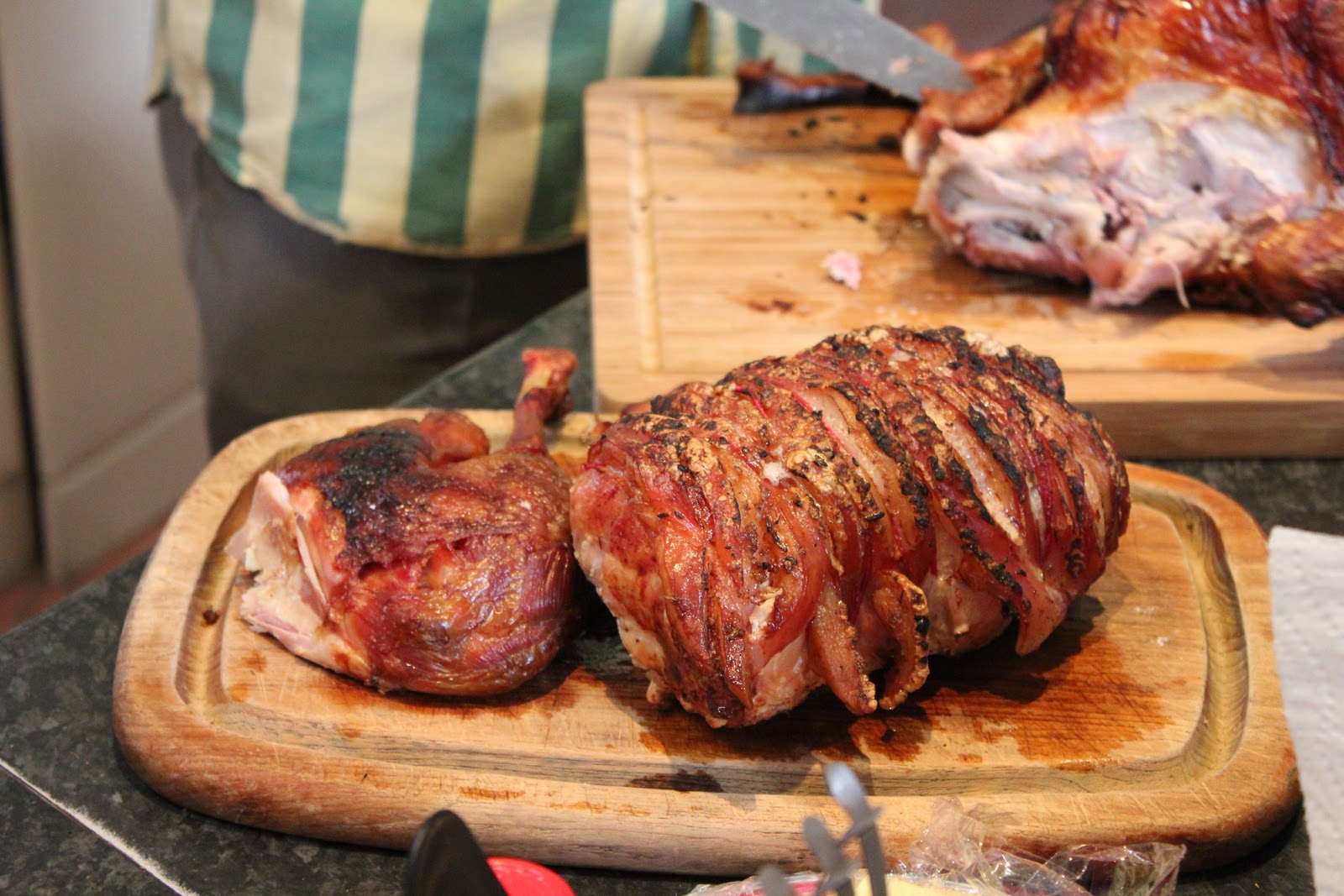
Nine of us sat around the extended dining room table with turkey, pork and the most delicious baking tray of roast vegetables smothered in gravy. Desert of course was the traditional pudding or a trifle (or both if you were up to it by then).


Pork and Turkey for Christmas lunch with family.
 By mid afternoon the chairs, couches and even the floor seemed to be littered with relining bodies suffering from an over indulgence of superb food and wine.


Plating up by my Sister in-law Jan while Bro in-law carves.
 An early night might have been the wise thing to do but "Back to the Future III" was on TV and I just needed to watch it one more time.

Boxing day allowed me to burn off a few calories with an early morning ride before getting organised to visit friends, Peter and Lawrence on the other side of town - they live in Croydon at the foothills of Mount Dandenong.
Lawrence owns a horse called Maz. Sue loves horses and pre-me she loved riding regularly. I thought she would enjoy meeting my cycling friends and their horse. Prior to visiting Maz, we were treated to a great BBQ of meat and grilled veggies, yum, yum. Yes, more food.................


Maz being pampered by Lawrence and Sue.

Maz - a very affectionate horse with a lovely personality and so gorgeous.
 Maz is agisted in the northern hill country of Wonga Park. Its an area that has fond memories for me in my early cycling days. The rolling hills and views over the valleys are magic and I've cycled many kms there as a teenager and my 20s something period. Kangas and wallabies still bound through the hills.
As much as the Bay area is where Sue and I love living, the hills are still very special to me.

It's been a very enjoyable two days of Christmas and Boxing day - hope yours was the same.

Saturday, December 25, 2010

Today is Christmas day and our home is the gathering place for the family this year. Typically it will be warm and the BBQ will be in action, well the Weber actually which reminds me I need to start the coals going soon.

Usually being Saturday I would post an Australian song so here we have Jingle Bells Australian style and Olivier Newton John from 1966 sing "Christmas Down Under"and probably one of her first TV appearances.


Have a happy and safe festive season to all our readers. Merry Christmas.